[Graduate Innovation Academic Forum]
Shaping Sustainability from Above: The Influence of Foreign Suppliers on Customer Firms’ Environmental Performance
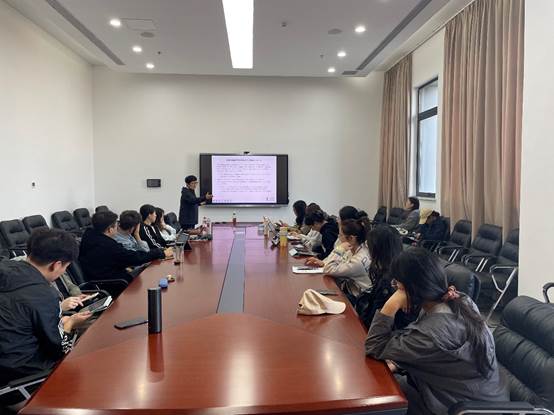
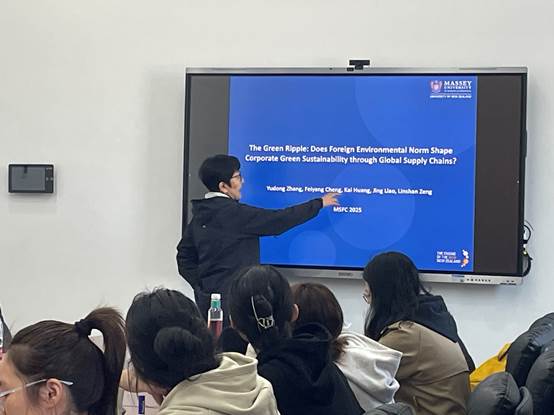
(Reporter: Bi Qingyang) On November 5, 2025, the School of Law and Business (Intellectual Property School) of Wuhan Institute of Technology hosted a remarkable academic event. Dr. Liao Jing, Associate Professor from Massey University in New Zealand, was invited as a guest speaker to deliver a cutting-edge lecture centered on "the cross-border diffusion of environmental norms in supply chains" for the college’s Finance program. The lecture focused on exploring how foreign suppliers have emerged as the "hidden driving forces" behind the green transition of Chinese enterprises.
In her presentation titled Shaping Sustainability from Above, Dr. Liao Jing shared a groundbreaking research finding that challenges conventional wisdom: the motivation for Chinese enterprises to improve their environmental performance is increasingly derived from their international partners. Her research clearly points out that foreign suppliers from countries with higher environmental standards are effectively "transferring" sustainability concepts and practices to their Chinese customer firms through procurement requirements and cooperation standards, thus implicitly acting as "environmental coaches".
Dr. Liao Jing further analyzed the micro-mechanisms underlying this process. She noted that the influence of foreign suppliers is not limited to simple pressure; instead, it has successfully stimulated the internal "environmental commitment" of customer enterprises. This means that Chinese enterprises have begun to proactively integrate environmental protection into their corporate strategies, rather than responding passively. She also offered some advice for the students’ research and studies: obtaining positive or negative feedback in the research mechanism is more conducive to understanding academic papers and communicating with supervisors.
Meanwhile, the research also precisely identified the types of enterprises that are more susceptible to such cross-border influence. First are enterprises under global scrutiny: those with high "Scope 3 emissions" and subject to intense attention from international stakeholders are the most sensitive to this influence. Second are "top performers" in the international market: enterprises whose products are highly dependent on exports to overseas markets will take the initiative to align with international environmental standards to maintain competitiveness. Third is the "protective effect" of local networks: the research also found that for enterprises with stable domestic supply chain alliances, the environmental driving force exerted by foreign suppliers is relatively weakened. This reveals that robust local cooperation networks can serve as a buffer zone, partially shielding enterprises from external green shocks.
During the interactive Q&A session, from a finance perspective, the students discussed with Dr. Liao Jing the fundamental differences between Chinese and U.S. listed companies: Chinese listed companies are dominated by state-owned capital and state-owned equity, while U.S. listed companies are more enterprise-centric. In-depth discussions were also held on topics such as "how to quantitatively assess environmental risks" and "the financial value of green supply chains". The venue was abuzz with intellectual exchanges and rounds of applause.
This lecture not only broadened the postgraduate students of Finance’s understanding of the connection between global supply chains and sustainable development, but also enlightened future finance professionals that the "green content" of supply chains has become an indispensable core dimension in evaluating enterprise value and risks.
The lecture concluded successfully in a lively atmosphere, marking a solid step forward for the School of Law and Business in integrating international cutting-edge academic resources and cultivating interdisciplinary talents with a global perspective.